Quiltmaking 103 - Basic Pattern Drafting
(Reference Patchwork Patterns by Jinny Beyer; 1979: McLean, VA; EPM Publications, Inc.)
How many of us have been browsing through a book or walking through a flea market or local antique store and spotted the quilt to end all quilts. This quilt is beautiful; this quilt is awe inspiring. You want to make a quilt like this one, but obviously there's no published pattern to go by. Now, there are a few options here. You might go on the Internet or delve through your quilting books for a pattern similar to the one you've seen. You might even be lucky enough to find the block pattern, but the block size isn't what you want. What to do, what to do?
The obvious solution is to draft your own pattern, to the size you want. To identify what each block or blocks look like, begin in the corner of the quilt where it's easier to see the beginning of a block unit. Some apparently complicated patterns may actually be composed of two quite simple blocks alternated in the setting. You may also find that what looks like part of a block when you're viewing the center of a quilt turns out to be part of the sashing when you start looking at a corner. Once you've identified the block or blocks, you can begin to draft your pattern.
Block patterns are geometric, and the trick lies in finding the underlying geometry. For our purposes, that basic geometry is a grid. Many traditional block patterns are actually based on only three basic grids. These grids can also help you choose which blocks will combine harmoniously in your quilt.
So, let's begin by looking at the three basic grids we'll be using.
| Four-Patch |
Nine-Patch |
25-Patch or 5 by 5 |
 |
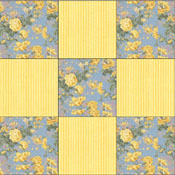 |
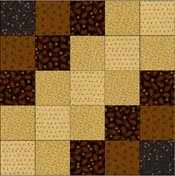 |
These basic grids are often further broken down by dividing sections of the grid. The divisions can be horizontal and/or vertical, like the "double" blocks below.
| Double 4-Patch |
Double 9-Patch |
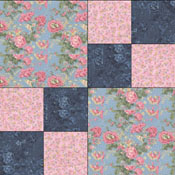 |
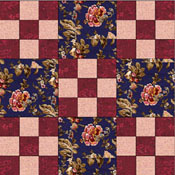 |
The divisions with in the grid may be diagonal. Sometimes, sections of the basic grid may disappear entirely.
| from 4-Patch |
to Windmill |
or to Hourglass |
|
 |
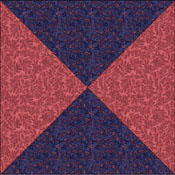 |
| from 9-Patch |
to Old Maid's Puzzle |
or to Birds in the Air |
|
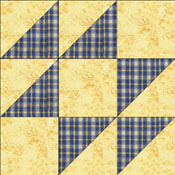 |
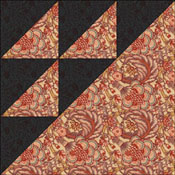 |
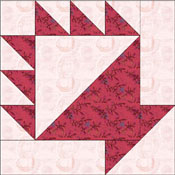
| from Building Blocks |
to Wedding Ring |
or to Cakestand |
|
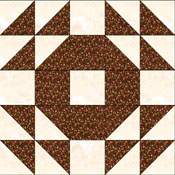 |
 |
buttons courtesy of GR Graphics
|